


Highway Heroes: Truck Manager
PIXEL FEDERATION, s.r.o.
Highway Heroes: Truck Manager caught my attention because it approaches the strategy genre through the familiar fantasy of running a transport business. Instead of asking me to win battles or build a medieval kingdom, it puts the focus on trucks, routes, customization, and gradual expansion. That change of setting gives the game a more grounded personality, and I found its appeal strongest when I treated each decision as part of a growing logistics company rather than as a series of isolated upgrades.
It is a free strategy game from PIXEL FEDERATION, s.r.o., designed for players who enjoy management, planning, and the satisfying feeling of turning a modest operation into something much larger. The store summary points toward building a company, customizing vehicles, transporting goods, and expanding, and those ideas define the experience I had. The game is rated for Everyone, so its presentation is approachable rather than harsh or intimidating, although the business model still deserves attention before anyone commits to long sessions.
My first impression: a friendly business sim with a road-trip identity
The first thing I noticed was how clearly the game communicates its central fantasy. The trucks are not just decorative pieces placed inside a generic management interface; they are the visual language of the whole experience. Roads, vehicles, cargo movement, and company growth all point toward the same idea: I am building a transport business and trying to make every part of it work more effectively.
That focus makes the opening experience easier to understand than many strategy games that throw several unrelated systems at the player. I could quickly grasp the basic loop: make choices about transportation, improve the operation, and use the results to support further growth. The concept is not difficult to approach, but it still leaves room for the kind of small decisions that keep a management game interesting after the initial novelty fades.
I also appreciated that the setting gives the game a calmer identity than a typical competitive strategy title. There is no need for a dramatic fantasy story to justify every action. The pleasure comes from seeing a company become more capable. For me, that made the game particularly suitable for short visits during the day, when I wanted something purposeful but not emotionally exhausting.
Related News






The current version is 2.10.0, and the game has already attracted over one hundred thousand installs. Its average rating is 4.6 from around two thousand ratings, with roughly one hundred sixty written reviews. Those figures suggest that the concept has found an audience, but they do not replace personal fit: someone who dislikes optimization or repeated management decisions may still find the pace too methodical.
One useful way to approach the opening is to resist spending resources simply because an upgrade is available. I found it more helpful to ask what is currently slowing the company down. If transport capacity, vehicle flexibility, or expansion is the immediate obstacle, that priority should guide the next improvement. This sounds obvious, but management games often tempt players into buying whatever looks newest, and that can leave the operation feeling busy without becoming genuinely stronger.
The game works best when I played with a clear short-term goal. I might focus on improving the next stage of the business, preparing for a larger transport opportunity, or making the existing operation more efficient before expanding. Without that focus, the experience can become a sequence of taps rather than a strategy game. With it, even modest progress feels deliberate.
Gallery
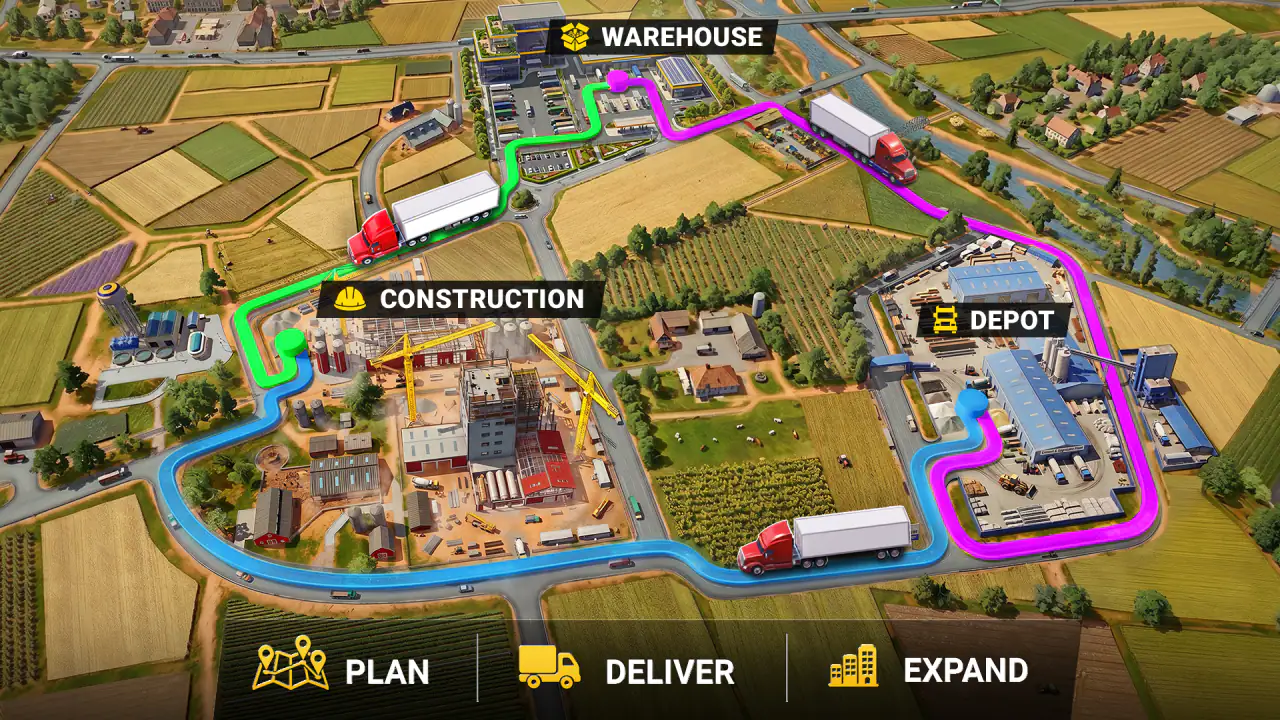
A world built from roads, cargo, and company growth
The setting is one of the game’s most coherent strengths. Highway Heroes: Truck Manager does not need elaborate lore to establish a sense of place. Its world language comes from the objects and actions that belong to the trucking business: vehicles with distinct visual presence, journeys that imply distance, and the gradual transformation of a small company into a more serious operation.
I liked that the visual direction supports the management fantasy without making the screen feel overly severe. The “highway heroes” idea gives the subject a touch of energy, while the business structure keeps the mood practical. That balance matters. A purely realistic presentation could make the game feel like a spreadsheet, while an excessively cartoonish one might weaken the feeling that my decisions have commercial consequences.
Customization also has an important role in this world. Even when customization is not the most strategically powerful action available, it helps make the company feel personal. I was more invested in the operation when the trucks felt like part of my business identity instead of interchangeable icons. This is a subtle strength: visual ownership can make routine management decisions more memorable.
At the same time, customization should be viewed as part of the game’s broader progression rather than as a substitute for planning. A better-looking fleet does not automatically solve an inefficient transport operation. My advice is to enjoy personalization after identifying the practical needs of the company. That creates a healthier balance between expression and progress.
The road setting also changes how I interpret time. In a conventional city-building game, growth is often represented by buildings spreading across a map. Here, expansion feels more connected to movement and commercial reach. The company becomes larger not only because it owns more assets, but because it can handle more transportation work. That gives progression a satisfying sense of direction, even when the individual actions are simple.
This is one of the less obvious reasons the game can appeal to players who normally avoid business simulators. The trucking theme gives abstract management decisions a concrete image. Instead of thinking only about numbers, I can imagine a working fleet, a growing route network, and a company trying to keep its promises. That mental picture adds personality to the strategy layer.
Sound and rhythm: why the mood matters
The game’s atmosphere depends heavily on rhythm. Transport management is naturally repetitive, so the experience needs to make repeated actions feel like part of a steady working day rather than a chore. I found the road-business theme most effective when I played in short, focused sessions: check the operation, make a few decisions, improve the weakest point, and return later.
That rhythm suits mobile gaming well. I would not describe the game as something I need to stare at continuously for a long uninterrupted session. Its appeal comes from returning to an ongoing business and deciding what deserves attention next. This makes it a practical companion for a commute break, a quiet evening, or a few minutes between other tasks.
The sound design contributes to the sense of motion and activity, but the important point is restraint. A truck-management game does not need constant dramatic effects to maintain interest. The road setting works better when the presentation supports concentration instead of fighting for attention. I could enjoy the sense of a functioning operation without feeling that every action had to be celebrated as a major event.
That measured pace will not suit everyone. Players who expect rapid rewards, constant surprises, or action-game intensity may find the experience too quiet. The game asks me to appreciate incremental improvement. A successful session is often one in which the company is slightly better organized than before, not one in which something spectacular happens every minute.
For everyday use, I recommend setting a simple session intention. Before opening the game, decide whether you are checking progress, planning an upgrade, or working toward expansion. This prevents the familiar mobile-game habit of opening an app automatically and tapping through screens without understanding why. In my experience, the game feels more strategic when I give each visit a purpose.
The free entry point makes experimenting easy, but the in-app purchase range runs from $0.99 to $499.99 per item. That is important for anyone who prefers games with tightly controlled spending. I would approach purchases carefully, especially if the game becomes part of a daily routine. The most comfortable way to play is to decide in advance whether I am willing to spend and to avoid treating a purchase as a shortcut whenever progress slows.
Where the management mechanics fit—and where they do not
As a strategy game, Highway Heroes: Truck Manager is strongest when I connect several small choices instead of treating each one as independent. Vehicle decisions, transport activity, customization, and expansion belong to the same business picture. The game encourages me to think about how one improvement supports the next, which is more satisfying than simply collecting upgrades with no relationship between them.
A useful habit is to separate operational decisions from cosmetic ones. Operational choices should answer a clear business need: improving the part of the company that currently limits growth or makes progress feel inefficient. Cosmetic choices can then give the fleet personality without confusing appearance with performance. Keeping those roles separate helped me avoid wasting attention on changes that looked attractive but did not solve my immediate problem.
Another trade-off appears in expansion. Growing quickly sounds appealing, but expansion can be less satisfying if the existing operation is not ready to support it. I preferred strengthening the current business first, then using expansion as a response to improved capacity rather than as a desperate attempt to escape a bottleneck. This approach makes the company feel more stable and gives each new step a reason.
The game also benefits from a “review before upgrade” workflow. Before making a significant change, I look at what has improved recently and what still feels slow. If the same problem remains after several sessions, that is a stronger signal than a new feature simply looking attractive. This small pause turns the game from a checklist into a process of diagnosing the business.
For players comparing it with other strategy games, the main difference is emotional rather than purely mechanical. A city builder usually makes space and construction the central fantasy. A traditional tycoon may emphasize profits, markets, or complex business chains. Highway Heroes: Truck Manager places the identity of the company in its transport operation and fleet. That makes it a better choice for someone who wants logistics-flavored progress without committing to a dense economic simulator.
On the other hand, players who want deep financial modeling, detailed route optimization, or a simulation that behaves like professional logistics software may find the experience too approachable. Its strength is accessibility and theme, not the promise of turning every decision into a complicated mathematical exercise. I would choose a more specialized management game if precision and complexity were my main goals.
The Everyone age rating also reflects the game’s broad presentation. It is a comfortable recommendation for families and younger players who enjoy planning, provided spending habits are discussed when necessary. The purchase range means that “free” should be understood as free to start, not as a guarantee that every possible progression path will remain free. That distinction is worth explaining before handing the game to a child.
Device compatibility is another practical point: the game requires at least OS 10. Anyone using an older phone or tablet should check the operating system before expecting to install it. On supported devices, the most important factor is likely to be personal patience rather than reflexes. This is a game for thinking about the next business move, not for proving how quickly you can tap.
Who will enjoy the road, and who should take another route?
I would recommend it to players who like the feeling of building a company step by step, especially those who enjoy trucks, transport themes, and light-to-moderate strategic planning. It is also a good fit for people who prefer games that can be checked in small sessions. The combination of customization and expansion gives the experience enough personality to stand apart from a completely abstract resource manager.
A realistic everyday scenario would be opening the game during a lunch break, checking how the transport operation is progressing, and choosing one improvement that supports the next business goal. Later, I could return to review the result and decide whether to continue strengthening the current setup or begin expanding. That kind of stop-and-start routine matches the game’s natural rhythm better than trying to rush through every available action.
I would be more cautious about recommending it to players who need constant novelty. If your ideal mobile game is built around fast combat, immediate wins, or a large story campaign, the trucking-business structure may feel too repetitive. It is also not the best match for anyone who dislikes free-to-play economies or who finds optional purchases distracting, even though the game can be entered without paying.
Players who want a highly detailed truck simulator should also adjust their expectations. The appeal here is managing a company, not simply driving a vehicle from one place to another. Likewise, someone seeking a pure puzzle game may find the ongoing progression less sharply structured. The game sits between a casual tycoon and a transport-themed strategy experience.
One of its most useful qualities is that it gives players a reason to think in priorities. The best progress does not necessarily come from doing more actions; it comes from choosing the action that removes the current obstacle. That lesson carries over well to other management games, and it is the kind of insight that makes the experience more rewarding than its simple premise might suggest.
The atmosphere verdict: a coherent highway business with patient pacing
After spending time with Highway Heroes: Truck Manager, I see it as a focused strategy game whose art direction, road setting, sound, and pacing all support the same fantasy. It wants me to feel like I am guiding a transport company, not merely clicking through unrelated menus. The trucks provide visual identity, the highway theme gives progression a sense of movement, and the steady rhythm makes it suitable for short, thoughtful sessions.
Its limitations are closely tied to those strengths. The measured pace can feel slow, the management loop may become repetitive for players who need constant change, and the free-to-play purchase range calls for sensible boundaries. I also would not choose it over a deeper tycoon or a dedicated driving simulator if I wanted complex economics or hands-on road control.
Still, I think the game earns a place on the shortlist for anyone who wants approachable transport strategy with a clear visual identity. PIXEL FEDERATION, s.r.o. has built a concept that is easy to understand but offers enough room for personal priorities: improve the fleet, organize the business, customize the company, and expand when the operation is ready.
My final recommendation is to try it as a calm, goal-oriented management game rather than as an action title. If you enjoy watching a small operation become more capable and you can maintain discipline around optional spending, Highway Heroes: Truck Manager is an enjoyable road to take. I would start free, set a clear business goal for each session, and judge the game by how satisfying its gradual progress feels to me.
For my taste, that gradual progress is the reason to stay. The game does not rely on a dramatic setting to create interest; it finds its mood in the working life of a growing fleet. When I played with patience, each route, vehicle decision, and expansion choice felt connected to the same larger story: making a company more reliable, more personal, and better prepared for the next stretch of highway.
FAQs for Highway Heroes: Truck Manager
What is Highway Heroes: Truck Manager?
Highway Heroes: Truck Manager is a truck-focused management game where you build and operate your own transportation business. Instead of only driving vehicles, you are responsible for choosing trucks, managing routes, completing deliveries, expanding your fleet, and improving your company. The game combines strategy and progression, making it suitable for players who enjoy logistics, upgrades, and business simulation more than traditional racing.
How do you play Highway Heroes: Truck Manager?
Gameplay revolves around making practical management decisions. You select or unlock trucks, assign them to delivery jobs, monitor their performance, and use your earnings to improve the business. As the company grows, you can generally take on more demanding routes and invest in better equipment. Success depends on balancing income, operating costs, vehicle upgrades, and efficient use of your available fleet.
Is Highway Heroes: Truck Manager free to download and play?
The game can be downloaded without paying an upfront purchase price, but the exact free-to-play experience may include optional in-app purchases, advertisements, or time-saving features. These extras can help players progress faster, although they are not necessarily required to enjoy the core management gameplay. Before downloading, it is worth checking the store listing for current pricing, supported payment options, and any age or purchase restrictions.
Does Highway Heroes: Truck Manager require an internet connection?
Whether a permanent internet connection is needed can depend on the version and the feature being used. Basic management activities may work in some circumstances without a connection, while advertisements, cloud saves, updates, events, or account-related features may require online access. If you plan to play during travel or in areas with weak coverage, test the game offline first and confirm how progress is stored.
Is Highway Heroes: Truck Manager suitable for casual players?
Highway Heroes: Truck Manager is a good option for casual players who enjoy checking progress, making upgrades, and gradually expanding a virtual business. It does not demand the constant reflexes of an action game, so short play sessions can still feel productive. However, players looking for realistic truck driving controls or a fast-paced racing experience may find the management-focused design slower and less hands-on than expected.
Pros
- Simple controls make driving and managing trucks easy to learn.
- Truck upgrades provide a satisfying sense of progression.
- Short sessions suit quick gameplay breaks on mobile.
- Different routes add variety to deliveries and challenges.
- The colorful presentation is clear and approachable for casual players.
Cons
- Progress can become repetitive after completing similar delivery jobs.
- Some upgrades may require considerable time or in-game resources.
- Limited strategic depth may disappoint experienced management fans.
- Performance can vary on older phones during busy scenes.
- Frequent notifications may feel distracting if left enabled.


